The Challenge
5–6%
of global GHG emissions from air & maritime transport
25–30%
of airline operating costs from jet fuel
~60%
of shipping operating costs from bunker fuel
Core Question: Are carbon taxes alone sufficient to incentivize green technology adoption in transport oligopolies?
Utilization-Neutral Greening
Two types of greening investments:
Utilization-Neutral Sequential
- Winglets & aerodynamic upgrades
- Advanced hull coatings
- Engine/fleet modernization
- Weight reduction programs
Key: Cost independent of fleet utilization. Investment precedes pricing.
Not Utilization-Neutral Simultaneous
- Drop-in biofuels (SAF)
- Carbon offset purchases
- Operational fuel switching
Key: Green fuel scales with output. Decisions adjusted ad hoc.
Model Setup
Two-stage game with \(n\) differentiated firms (Bertrand competition):
1
Investment Stage
Firms choose \(g_i\)
2
Pricing Stage
Firms choose \(p_i\)
Profit function for firm \(i\):
$$\pi_i(p) = \left[p_i - \left(c_i + T_i(g_i)\right)\right] \cdot D_i(p) - C_i(g_i)$$- \(T_i(g_i)\): Tax payment per passenger, decreasing & convex in \(g_i\)
- \(C_i(g_i)\): Investment cost, increasing & convex in \(g_i\)
- \(c_i\): Unit operating cost
Main Result: Strategic Underinvestment
Proposition 1
Under a Pigouvian carbon tax in a differentiated Bertrand oligopoly with utilization-neutral investments, firms strategically underinvest in green technology relative to the welfare optimum.
Intuition:
- Green investments reduce effective marginal cost \(c_i + T_i(g_i)\)
- Lower marginal cost \(\rightarrow\) more aggressive pricing in Stage 2
- Firms withhold green investment to soften price competition
- This is the "puppy-dog ploy" (Fudenberg & Tirole, 1984)
Policy implication: Carbon taxes alone are too weak to generate welfare-efficient greening.
Duopoly with Cost Asymmetry
Benefit function:
$$B(q_1, q_2) = q_1 + q_2 - \frac{1}{2}\left(q_1^2 + q_2^2 + q_1 q_2\right)$$Demand system:
$$D_i(p_1, p_2) = \frac{2}{3}\left(1 - 2p_i + p_j\right), \quad j \neq i$$Duopoly: Tax, Cost & Scenarios
Tax & Cost Structure:
- \(T_i(g_i) = t - g_i\)
- \(C_i(g_i) = g_i^2/2\)
- \(c_1 = 0\) (low-cost firm)
- \(c_2 = c\) (high-cost firm)
Two Scenarios:
- Sequential (N): Investment \(\rightarrow\) Pricing
- Simultaneous (S): No strategic manipulation
Interpretation: The high-cost firm can alternatively be viewed as having equal costs but lower demand.
Sequential Equilibrium: Investments
Equilibrium investments:
$$g_1^N = \frac{56(30c + 19(1-t))}{1501}$$ $$g_2^N = \frac{56(-49c + 19(1-t))}{1501}$$Investment gap:
$$g_1^N - g_2^N = \frac{56c}{19}$$
Key insight: The low-cost firm invests more in green technology, but still underinvests relative to the welfare optimum due to strategic incentives.
Sequential Equilibrium: Prices
Equilibrium prices:
$$p_1^N = \frac{-209 - 330c + 1710t}{1501}, \quad p_2^N = \frac{-209 + 2040c + 1710t}{1501}$$Price gap:
$$p_1^N - p_2^N = -\frac{30c}{19}$$
High-cost firm charges more: higher unit cost \(\rightarrow\) higher prices (intuitive).
Sequential Equilibrium: Quantities
Equilibrium quantities:
$$q_1^N = \frac{60(30c + 19(1-t))}{1501}, \quad q_2^N = \frac{60(-49c + 19(1-t))}{1501}$$Quantity gap:
$$q_1^N - q_2^N = \frac{60c}{19}$$
Low-cost firm serves more passengers. The cost advantage translates into both higher investment and higher market share.
Strategic Underinvestment
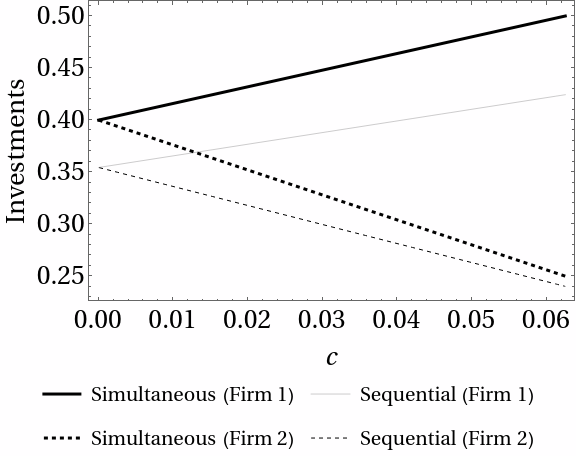
Figure 1a: Strategic Underinvestment
Effect on Passenger Quantities
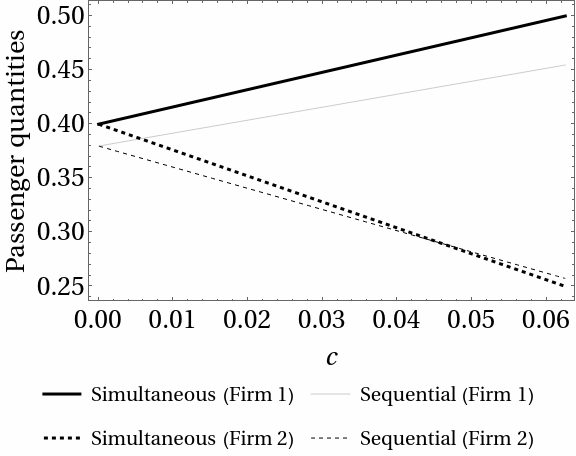
Figure 1b: Effect on Passenger Quantities
Welfare Impact
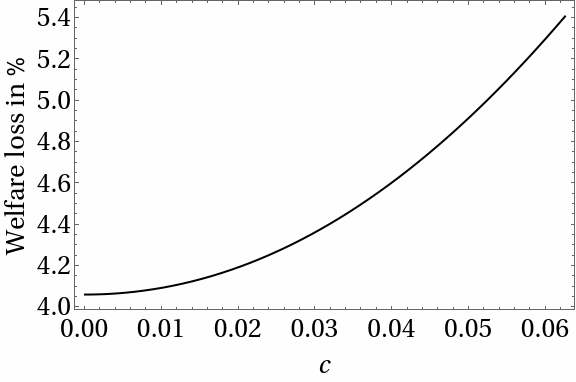
Figure 2: Welfare Loss from Strategic Underinvestment
Policy Implications
Carbon taxes are necessary but not sufficient. Strategic underinvestment implies Pigouvian taxes alone cannot achieve welfare-efficient greening.
Current Approach Problematic
- EU ETS + fuel policies (SAF mandates)
- Fuel policies are not technology-neutral
- Restrict abatement to specific pathways
- May increase overall greening costs
Our Recommendation Preferred
- Maintain carbon pricing (ETS/tax)
- Complement with technology standards
- Target utilization-neutral investments
- Fleet modernization mandates
- Hull coating / aerodynamic requirements
Why not fuel policies? Green fuel decisions are likely simultaneous, so strategic underinvestment does not apply. But fuel policies are inherently non-technology-neutral.
Conclusions
- Carbon taxes create perverse incentives: Firms strategically underinvest in utilization-neutral green technology to soften price competition.
- Cost asymmetries matter: Strategic effects are stronger for low-cost competitors. High-cost rivals may paradoxically expand output.
- Welfare losses are substantial: 4–5% welfare loss from strategic underinvestment in our parameterization.
- Policy complementarity is key: Carbon taxes should be combined with technology standards targeting fleet modernization, not just fuel mandates.
Future research: Extend to Cournot competition, dynamic settings, empirical calibration using aviation/shipping data, and analyze optimal standard design.
EU ETS Expansion: Extra-European Flights
Current situation: The EU ETS covers only intra-EEA flights (within Europe). The "stop-the-clock" derogation, in place since 2012, defers coverage of extra-European flights until at least 2027.
Proposed Changes EU Commission
- By July 2026, the Commission must assess whether more action is required for extra-European flights
- Subject to the assessment, a legislative proposal could extend the EU ETS to departing flights from EEA airports
- Incoming flights would be exempted
- Alternatively, maintain intra-European scope if CORSIA is strengthened
Assessment Criteria EU ETS Directive
- Has ICAO strengthened CORSIA in line with the Paris Agreement?
- Do CORSIA-covered countries represent ≥70% of international aviation emissions?
- If not, EU ETS expansion to departing flights from January 2027
My position (Czerny 2026): Covering interregional connections increases the effectiveness of the ETS. A global ETS would be ideal, but extending national ETSs to extra-regional connections is a practical second-best solution.
The EU ETS vs. CORSIA Debate
IATA / Industry Position Opposed
- EU ETS expansion would conflict with CORSIA, the single global market-based measure
- Risk of double burden — same emissions charged under both schemes
- Creates competitive distortion with non-European hubs
- May provoke retaliatory measures by third countries
- Calls for full CORSIA implementation on all international flights, including intra-EEA routes
- "Layering regional measures over a global framework creates redundant costs without environmental gain" — IATA, March 2026
My Counter-Arguments In Favor
- CORSIA is weak: only offsets emissions above 85% of 2019 levels; baseline was rolled back from 2019–2020 average to 2019 alone
- CORSIA credits priced at ~€3.20/tonne vs. EU ETS at ~€80/tonne — massive incentive gap
- Major emitters (China, India, Russia) not participating in CORSIA compulsory phase
- EU ETS is effective and efficient: caps emissions directly, incentivizes in-sector abatement
- CORSIA is an offsetting mechanism, not a strict reduction system
- Climate is a global problem; regional ETS expansion is a practical step toward broader coverage
Key tension: The aviation industry wants a single global scheme (CORSIA), but CORSIA lacks ambition and global participation. The EU ETS is more effective but faces political resistance. The EU must decide by July 2026.
Key References
- Bulow, J.I., Geanakoplos, J.D., & Klemperer, P.D. (1985). Multimarket oligopoly: Strategic substitutes and complements. JPE.
- Brander, J.A. & Spencer, B.J. (1983). Strategic commitment with R&D. Bell Journal.
- Fudenberg, D. & Tirole, J. (1984). The fat-cat effect, the puppy-dog ploy, and the lean and hungry look. AER.
- Pigou, A.C. (1920). The Economics of Welfare. Macmillan.
- Vives, X. (1999). Oligopoly Pricing: Old Ideas and New Tools. MIT Press.
- IEA (2025). Aviation & Shipping sector reports.
- IATA (2026). Fuel efficiency data.
- UNCTAD (2025). Seaborne trade statistics.